



In Rethinking Player Development — Why #MotorBall Starts Where Metrics Stop, we drew a clear distinction between measuring outcomes and understanding the systems that produce them.
That article challenged a familiar pattern in modern baseball: the tendency to treat late-stage metrics as explanatory, even when they only describe the visible endpoint of a much deeper coordination process.
This piece continues that conversation — but shifts the lens to one of the most common and quietly misleading labels in pitching development: pronators versus supinators.
Because few concepts expose the gap between observation and understanding more clearly than the way we talk about the arm.
The Labels Everyone Knows
If you work in pitching development long enough, you have heard them.
He’s a pronator.
He’s more of a supinator.
These labels appear everywhere: offseason conversations, video breakdowns, TrackMan reports, arm-care discussions, and draft-room evaluations. They feel familiar. They feel concrete. And judging by how frequently they surface, they feel useful.
But here is the uncomfortable truth:
Most of what we believe we understand about pronation and supination in pitching is framed at the wrong level of the system.
This article is not about arguing whether pronation or supination exists. It does.
It is about explaining why treating these labels as causal explanations — or worse, coaching instructions — quietly undermines player development.
What We’ve Been Taught to See
Traditionally, pronation and supination are discussed as arm-centric traits:
Forearm rotation patterns
Arm slots and release tendencies
Pitch-type associations
Stress profiles at the elbow or shoulder
From there, it is a short step toward prescriptive thinking:
If he’s a pronator, he should throw this.
If he’s a supinator, we need to clean that up.
On the surface, this logic appears reasonable. We observe something at release, assign a label, and attempt to manage it.
But this logic rests on a hidden assumption:
That is what we observe at the arm is the source of the movement.
That assumption is where things begin to break.
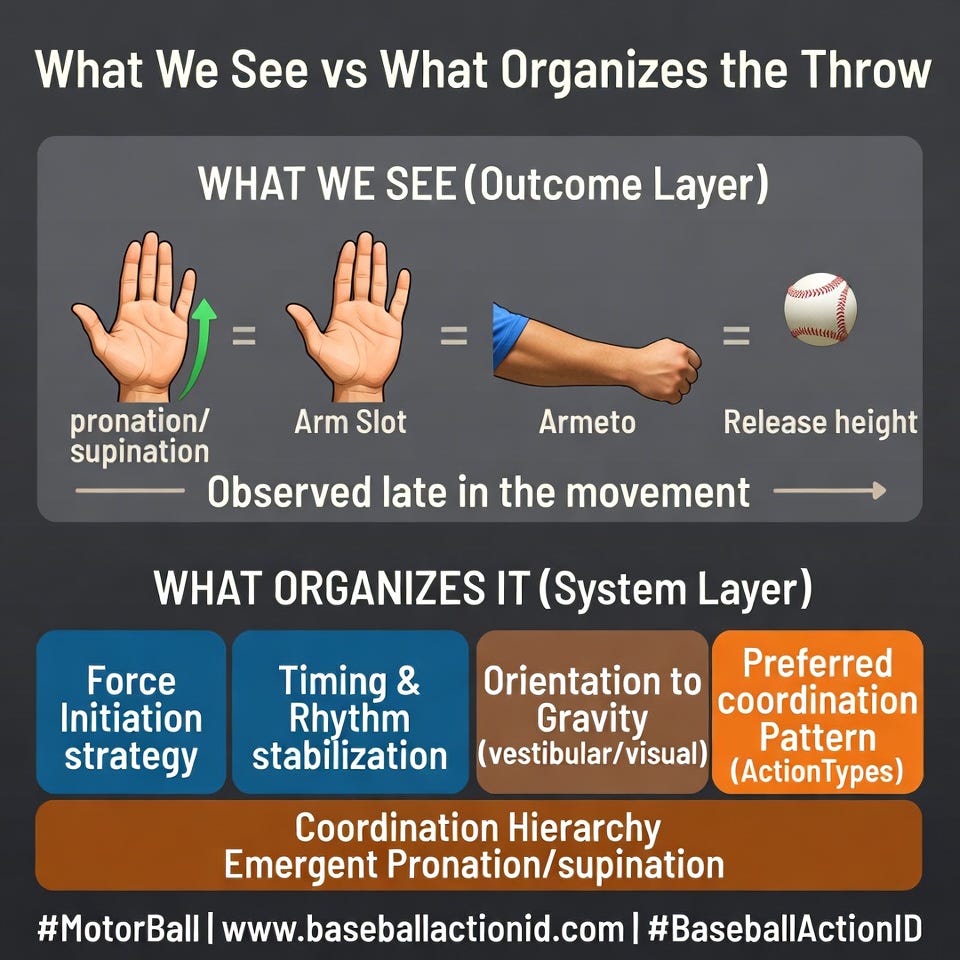
Pronation and Supination Are Outcomes — Not Instructions
Pronation and supination at release are not independent mechanical choices made by the forearm.
They are emergent outcomes of how the entire system organizes itself to throw a baseball.
What appears on the arm reflects:
How force is initiated earlier in the movement
How timing and rhythm are stabilized
How the athlete orients relative to gravity and space
How the nervous system resolves constraints under speed and stress
In other words:
The arm does not decide to pronate or supinate.
The system arrives there.
Two pitchers can display similar pronation at release for completely different underlying reasons. Those differences matter far more than the label itself — because they determine whether the movement will stabilize, adapt, or eventually break down.
Why the Labels Become Dangerous
The problem is not the observation.
The problem is where the interpretation stops.
When pronator and supinator labels are treated as identities rather than outcomes, several predictable issues emerge.
1. The Arm Becomes the Intervention Target
Coaching attention collapses toward the forearm and hand, even though the behavior being observed is organized upstream.
The result is arm-level cueing for a system-level problem.
2. Natural Solutions Are Misread as Flaws
What appears as “excessive” pronation or “late” supination is often the system’s most efficient solution given the athlete’s timing, force strategy, and coordination preferences.
Labeling that solution as a flaw invites unnecessary correction.
3. Standardization Replaces Understanding
Once labels become institutionalized, they spread.
Similar-looking release behaviors are grouped, even when the underlying organization is fundamentally different. What works for one pitcher is transferred to another — quietly destabilizing both.
The Parallel With Release-Focused Analysis
If this sounds familiar, it should.
This is the same structural mistake made in release-focused pitching analysis.
We observe something late in the movement:
release height
arm slot
pronation or supination
And we treat that snapshot as explanatory.
But just like release metrics, arm labels describe what happened, not why it happened.
They capture the endpoint of coordination — not the organizing logic that produced it.
Where the Real Story Lives
To understand pronation and supination meaningfully, we must move upstream.
We must ask different questions:
Where does this pitcher naturally initiate force?
How does he stabilize timing under speed?
How does he organize movement relative to gravity?
What coordination pattern does his nervous system trust under pressure?
Only then does what we see at the arm begin to make sense.
Without that context, pronator and supinator labels are incomplete at best — and misleading at worst.
This Is Not a Call to Ignore the Arm
To be clear: the arm matters.
But it matters as part of a system — not as an isolated control surface.
When we coach the arm without understanding the system that delivers it to release, we confuse visibility with causality. And in doing so, we risk correcting the very adaptations that allow an athlete to perform.
From Labels to Understanding
So the real question is not:
Is this pitcher a pronator or a supinator?
It is:
What kind of system produces this behavior — and why does it work for him?
That shift — from labeling outcomes to understanding organization — is where development actually begins.
And it is exactly the gap #MotorBall is built to address.
Before we label the arm, we have to read the athlete.
Otherwise, we are not developing pitchers.
We are simply reacting to what we can see.